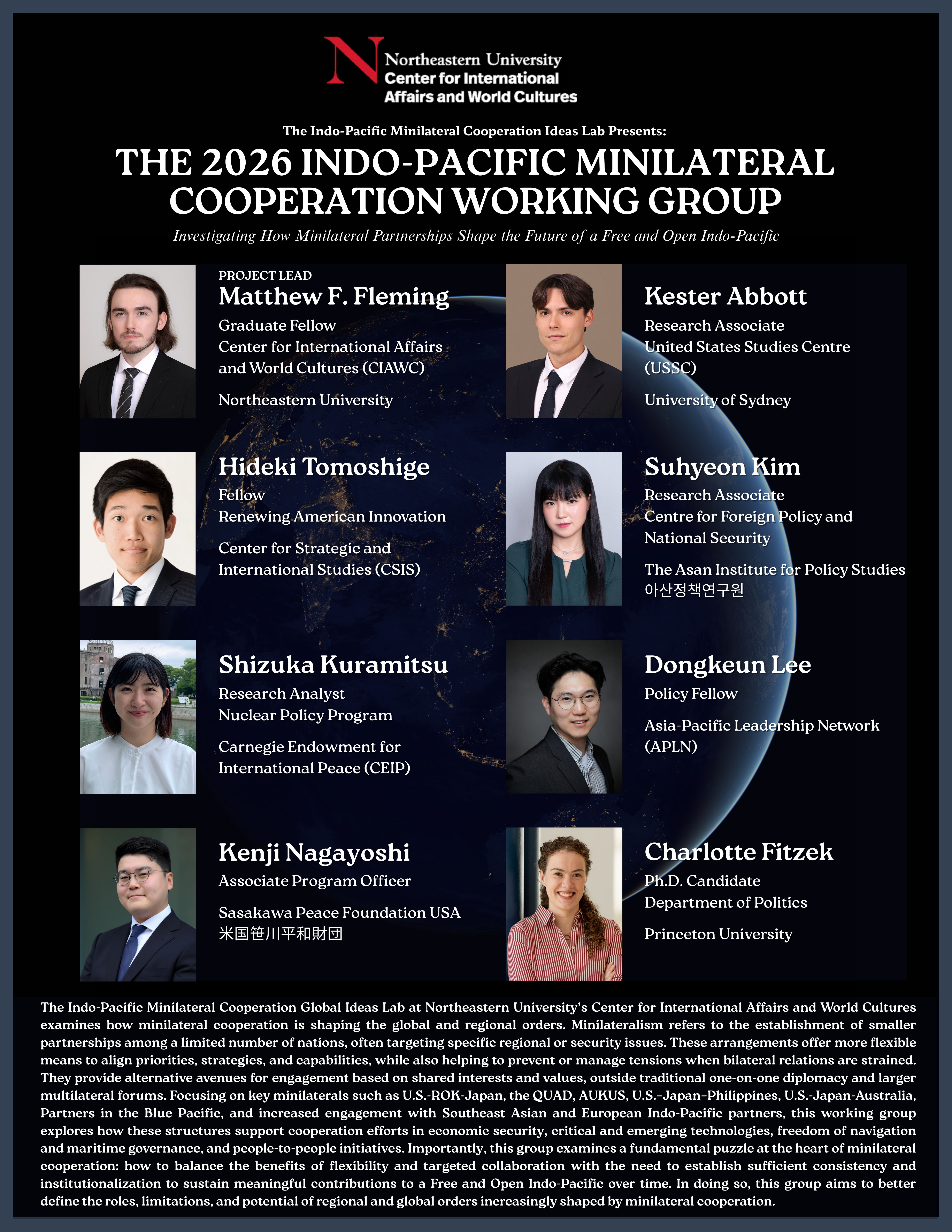
The Indo-Pacific Minilateral Cooperation Ideas Lab
Project Lead: Matthew F. Fleming
Supported by: The Center for International Affairs and World Cultures
The Indo-Pacific Minilateral Cooperation Ideas Lab at Northeastern University’s Center for International Affairs and World Cultures examines how minilateral cooperation is shaping the global and regional orders. Minilateralism refers to the establishment of smaller partnerships among a limited number of nations, often targeting specific regional or security issues. These arrangements offer more flexible means to align priorities, strategies, and capabilities, while also helping to prevent or manage tensions when bilateral relations are strained. They provide alternative avenues for engagement based on shared interests and values, outside traditional one-on-one diplomacy and larger multilateral forums. Focusing on key minilaterals such as U.S.-ROK-Japan, the QUAD, AUKUS, the U.S.–Japan–Philippines, U.S.-Japan-Australia, Partners in the Blue Pacific, and increased engagement with Southeast Asian and European Indo-Pacific partners, the 2026 working group explores how these structures support cooperation efforts in economic security, critical and emerging technologies, freedom of navigation and maritime governance, and people-to-people initiatives. Importantly, this working group examines a fundamental puzzle at the heart of minilateral cooperation: how to balance the benefits of flexibility and targeted collaboration with the need to establish sufficient consistency and institutionalization to sustain meaningful contributions to a Free and Open Indo-Pacific over time. In doing so, this group aims to better define the roles, limitations, and potential of regional and global orders increasingly shaped by minilateral cooperation.
Evolving Rhetoric of Indo-Pacific Strategies and Frameworks of Engagement
Primary Investigator: Matthew F. Fleming
Supported by: The Pacific Forum’s James A. Kelly Korea Fellowship
The James A. Kelly Korean Studies Fellowship Program will promote academic study, research, and professional career paths focused on Korean Peninsula. It recognizes the exemplary efforts of Jim Kelly to improve US-ROK relations and encourage the DPRK to denuclearize and join the international community of nations. The overall objective of the fellowship is to promote stronger US-ROK, US-DPRK, and inter-Korean relations through a variety of Pacific Forum programs. The fellowship makes a deliberate effort to encourage the study of Korean economic and security issues, focusing on raising awareness among the next generation of scholars and officials in the U.S., ROK, and worldwide about the Korean Peninsula’s vital role in regional and international affairs. Kelly Fellows will develop their knowledge of Korean Peninsula issues through participation in the Pacific Forum’s Young Leaders program, research under the guidance of Pacific Forum senior staff, and the continuing series of U.S.-ROK and broader tri-/multilateral forums.

Transnational Political Networks and the Future of Global Order Project
Primary Investigator: Mai’a K. Davis Cross
Supported by: A grant from the Carnegie Corporation of New York
Fleming is a research assistant on this project. In October 2024, the Center launched its flagship program entitled, “Transnational Political Networks & The Future of Global Order.” Transnational political networks – groups of individuals who transcend national boundaries – are major forces shaping global order, even despite great power competition. They have championed groundbreaking ideas for international cooperation across a wide range of issue areas, such as climate change, nuclear weapons, outer space, and artificial intelligence. Under Professor Mai’a Cross’s leadership, the Center for International Affairs and World Cultures aims to break new ground in the investigation of transnational political networks through its focus on the types of networks that matter and how they gain influence. At both the societal and elite levels, certain networks have social power, derived from the legitimacy of their ideas, which are often ultrasocial in nature (i.e. inclusive, empathic, and aimed at the common good), global, and transformational. This flagship project (1) investigates why certain transnational political networks achieve (or fall short of) breakthroughs in international cooperation that were previously thought impossible, (2) identifies emerging issue areas where their impact is being felt, and (3) translates that knowledge into practical steps that empower these actors to contribute to solutions to disruptions in global order. Please see here for regular updates on this important work.
 Matthew F. FLEMING